
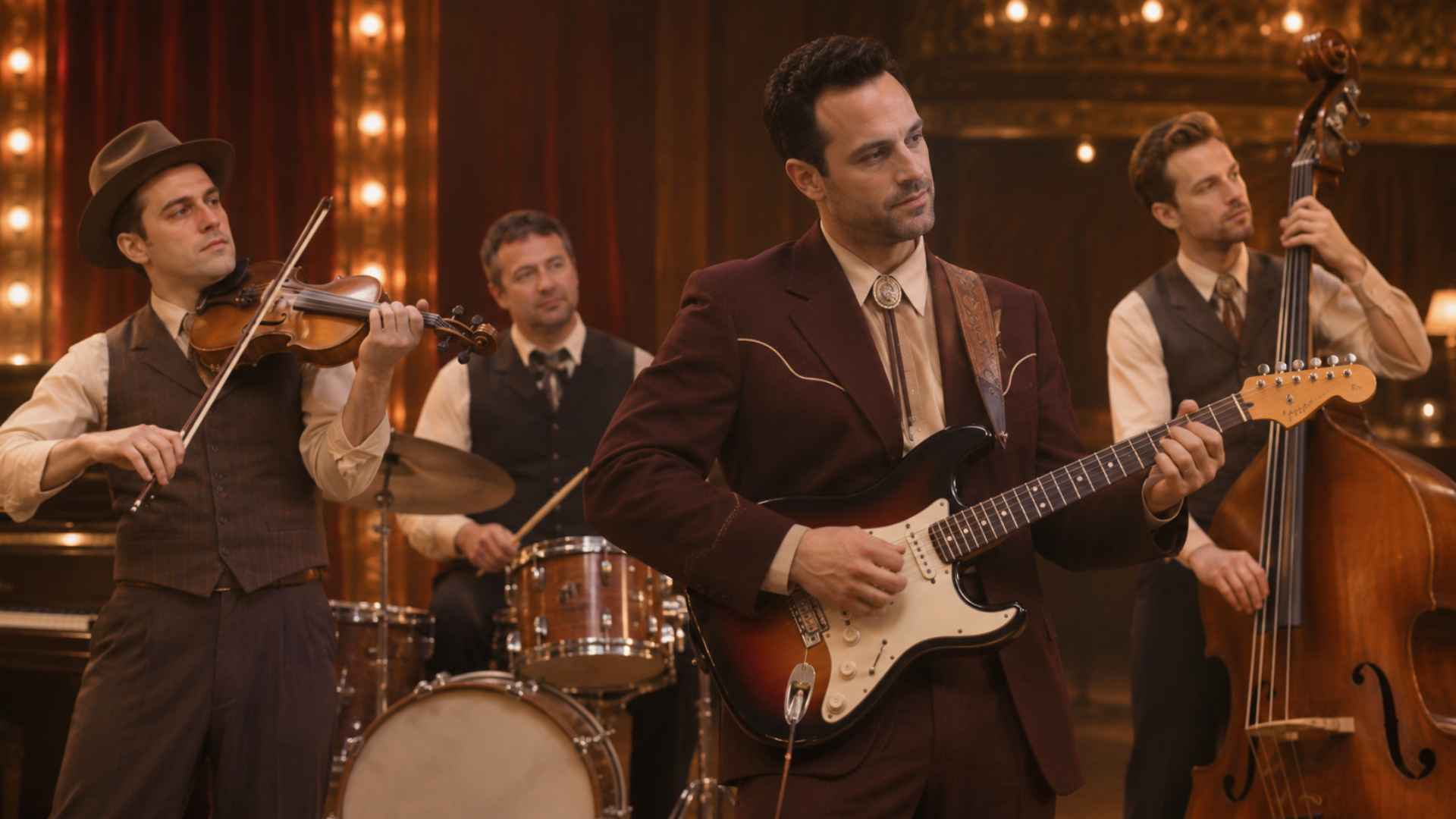
Western swing developed in the American Southwest during the early twentieth century, bringing country fiddle traditions into contact with jazz, blues, and popular dance music. Early groups often centered on fiddle, acoustic guitar, and voice, while larger dance ensembles later incorporated drums, steel guitar, piano, and horns. Its sound depends on more than the presence of particular instruments. The relationship between a steady rhythm section, melodic leads, and improvised passages gives the style its character. Bands may range from a compact string ensemble to a larger group with piano and horns, yet the central aim remains a clear beat that supports dancers.
The repertoire associated with western swing includes fiddle tunes, vocal numbers, blues, and jazz standards. Much of the music uses 4/4 time, although waltzes in 3/4 also appear in dance band programs. Arrangements generally leave room for individual players while keeping melodies recognizable. For listeners interested in ensemble music, western swing offers a useful example of how instruments with different tones can share rhythmic and melodic responsibilities without competing for the same space.
Fiddle, Steel Guitar, and the Band’s Instrumental Colors
The fiddle occupies a prominent position in western swing. Unlike a classical violin section that usually follows a written orchestral score, western swing fiddlers frequently interpret melodies with slides, rhythmic accents, and improvised variations. Some bands use two or more fiddles, allowing players to harmonize a tune or alternate between melody and supporting lines. Parallel thirds and sixths are common ways to create two part harmony, although the specific intervals change with the underlying chords.
Steel guitar adds another recognizable voice. Early western swing ensembles used non pedal steel guitars played with a bar that moves across the strings, producing smooth pitch changes and sustained notes. Amplification helped these instruments project alongside drums and other amplified instruments. Pedal steel guitars became more prominent in country music during the mid twentieth century and can also appear in later western swing groups. Unlike a fretted guitar, its sliding bar does not provide fixed fret positions, so accurate pitch depends heavily on the player’s ear and hand control. Steel guitar often answers a sung phrase, introduces a verse, or takes an instrumental solo rather than playing continuously.
Rhythm Section Roles and Harmonic Structure
Rhythm guitar, bass, and drums establish the foundation for the ensemble. Guitarists often play short, regular chord strokes that define the pulse without obscuring the melody. Bass players may emphasize beats one and three in a two beat feel or play a walking line with one note on each quarter note beat. Drummers support these patterns through bass drum, snare, cymbals, and hi hat, adjusting their volume to suit the room and the number of musicians. Swing phrasing also affects the subdivision of a beat: paired eighth notes are often unequal in length, with the precise ratio changing according to tempo and interpretation. The result is a coordinated groove rather than several instruments independently marking time.
Piano can expand the rhythmic and harmonic range. Its left hand may reinforce bass movement while the right hand supplies chord voicings, fills, or short melodic replies. Horns such as trumpet, trombone, and saxophone add another layer in larger groups, particularly during arranged introductions and ensemble passages. Western swing draws on common popular song forms, including the 12 bar blues and 32 bar song structures. These repeating patterns help performers anticipate chord changes and create improvised solos while the rest of the band maintains a stable framework.
Musical Arrangements for Different Band Sizes
Small western swing groups must distribute musical tasks carefully. In a lineup of fiddle, steel guitar, rhythm guitar, bass, and drums, one lead instrument can state the tune while the other supplies fills between vocal lines. When the fiddle takes a solo, the steel guitar can reduce its activity or play sustained chord tones. During a steel guitar solo, the fiddle may rest entirely. This use of contrast makes each featured passage easier to hear and prevents the middle register from becoming crowded.
Larger bands can divide players into sections and write coordinated figures for fiddles, horns, or both. Short repeated phrases, often called riffs, create momentum behind a soloist. An arranged ensemble passage may then bring the full band together before the return of a vocal verse. These shifts between solo and group textures also change the perceived intensity without requiring every musician to play louder. Charts can indicate chord symbols, repeated sections, breaks, and cues for solo entries, helping players maintain the form when arrangements become longer. Written charts are useful for complex entries and harmonies, but many western swing performances still depend on musicians listening and reacting to one another.
Tempo, song order, and dynamics matter as much as instrumentation. Dance sets often alternate lively two step numbers with slower songs or waltzes, giving the audience a change of pace. Introductions establish the key and pulse; short instrumental breaks connect verses; endings need clear signals so the entire ensemble stops together. Rehearsal can focus on transitions, solo lengths, and the placement of fills. With those decisions settled, a band can preserve the flexible character of western swing while presenting melodies, rhythms, and harmonies in a coherent arrangement.