
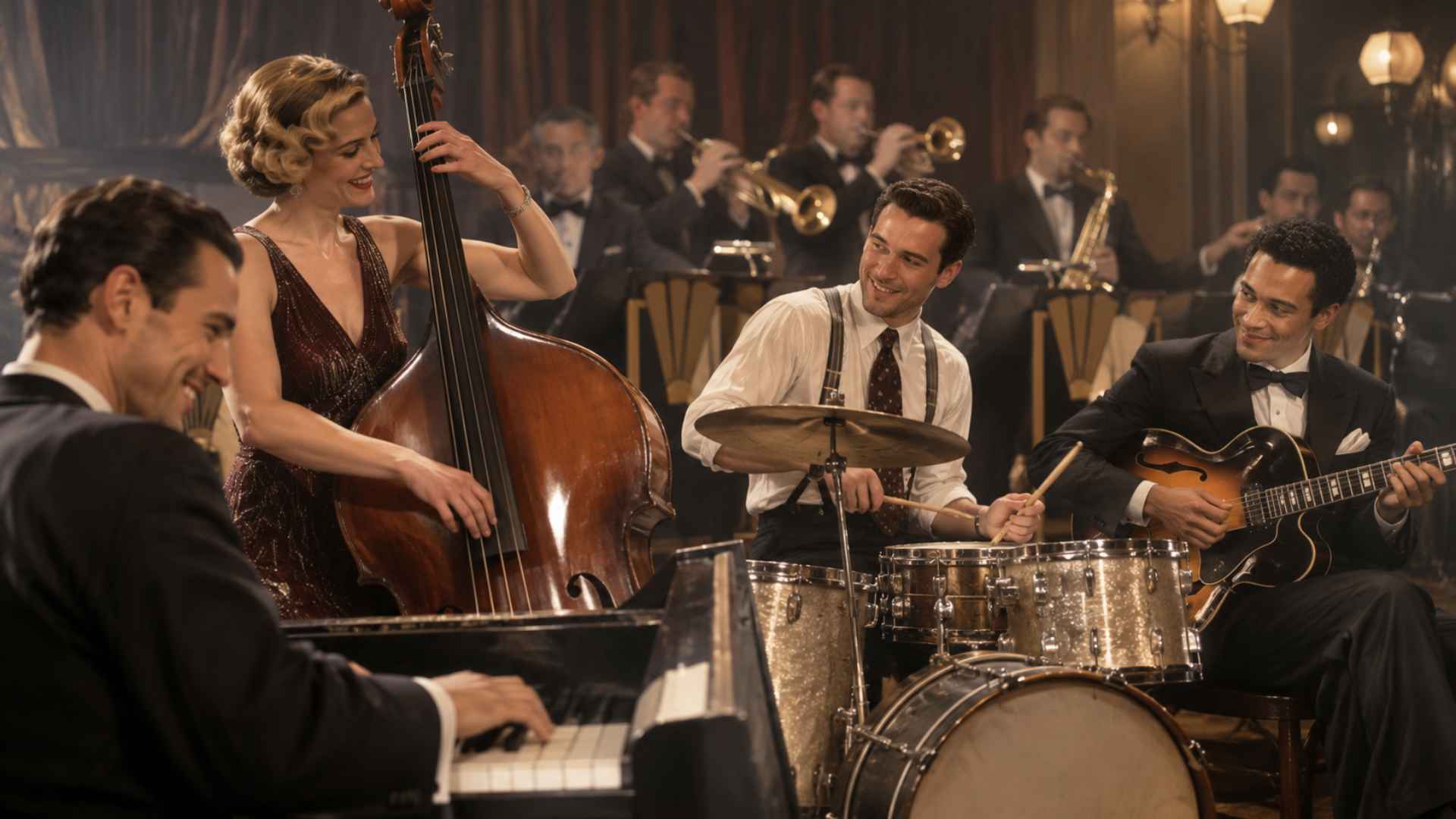
Swing music earns much of its character from an interaction between written arrangements and a flexible rhythmic foundation. Horn sections may carry memorable melodies, but bass, drums, piano, and guitar establish the motion that makes those phrases feel connected. Their contribution goes beyond keeping the beat. They shape accents, support changing harmonies, and leave space for soloists, giving a large ensemble the relaxed momentum associated with swing era dance music.
During the big band era of the 1930s and 1940s, bandleaders relied on arrangements that could coordinate multiple brass and reed players. Rhythm sections helped those carefully written passages sound lively rather than mechanical. Repeated figures in the horns could build excitement while the accompanying instruments maintained a steady pulse. Small rhythmic adjustments in the accompaniment often changed the energy of an entire passage without altering its melody.
Swing feel is not a rigid mathematical formula. Eighth notes may be unevenly spaced, but their proportions vary with tempo, phrase, and individual style. Accents and articulation also contribute to the groove. A band can play technically correct notes and still sound stiff if the rhythm section does not listen to the rest of the ensemble. Effective swing develops through coordinated time, responsive dynamics, and shared phrasing.
Bass Lines and the Four Beat Foundation
Walking bass lines are closely associated with mainstream swing. The bassist commonly plays a note on each quarter note beat, outlining chord tones and connecting harmonies with passing notes. This steady motion helps dancers and instrumentalists anticipate the pulse. It also makes complex chord sequences easier to follow. Good lines balance forward movement with clarity, rather than treating every beat as an opportunity for unnecessary melodic decoration.
The shift toward four beat rhythm helped distinguish many swing performances from earlier two beat accompaniment patterns. Bass players might still alternate between the approaches according to tempo, arrangement, or dramatic effect. In either case, the instrument works closely with the drummer’s timekeeping. Slight differences in attack and note length affect whether the ensemble feels grounded, hurried, or unusually relaxed, even when its measured tempo remains unchanged.
Drums, Piano, and Guitar in Ensemble Texture
Swing drummers supply pulse and accents through combinations of cymbals, snare drum, bass drum, and hi hat. Earlier dance band styles often emphasized bass drum and hi hat patterns, while later jazz developments gave the ride cymbal a more prominent timekeeping role. The drummer also marks transitions with fills and supports brass figures with coordinated accents. Constant heavy playing can obscure the arrangement, so restraint is a significant musical skill.
Pianists and guitarists contribute harmony and rhythm through chord voicings and repeated accompaniment patterns. In many swing bands, guitarists maintained a steady four beat strum, while pianists placed chords where they supported rather than crowded the texture. The exact division varied among ensembles. When a piano or guitar reduces its activity during a solo, that space can make the bass line and percussion more audible without weakening the underlying pulse.
Arrangement Choices That Give Swing Its Motion
Arrangers frequently use riffs, short repeated melodic figures, to organize exchanges between sections. Saxophones might state a phrase that trumpets answer, with the rhythm section maintaining continuity between them. Sudden breaks create anticipation by briefly removing part of the accompaniment. When the full band returns, the contrast feels stronger because listeners have heard the established pulse disappear and reappear at a deliberate moment.
Dynamics are another part of rhythmic design. A soft piano passage can gain intensity as the bassist walks more assertively and the drummer adds accents, even before the horns increase volume. Solos require particular sensitivity because the accompanists must follow changes in phrasing without abandoning the tempo. Their best decisions are often nearly invisible: a lighter chord, a shorter fill, or a bass note placed with greater intention.
Swing arrangements remain recognizable because their sections behave like parts of a conversation. Written horn lines provide structure, while the rhythm players continually respond to phrasing, harmony, and energy. No single instrument creates the feel alone. When bass, drums, piano, and guitar work as a coordinated unit, even a dense arrangement retains the lift and movement that made swing central to twentieth century jazz and popular dance music across different tempos and settings.