
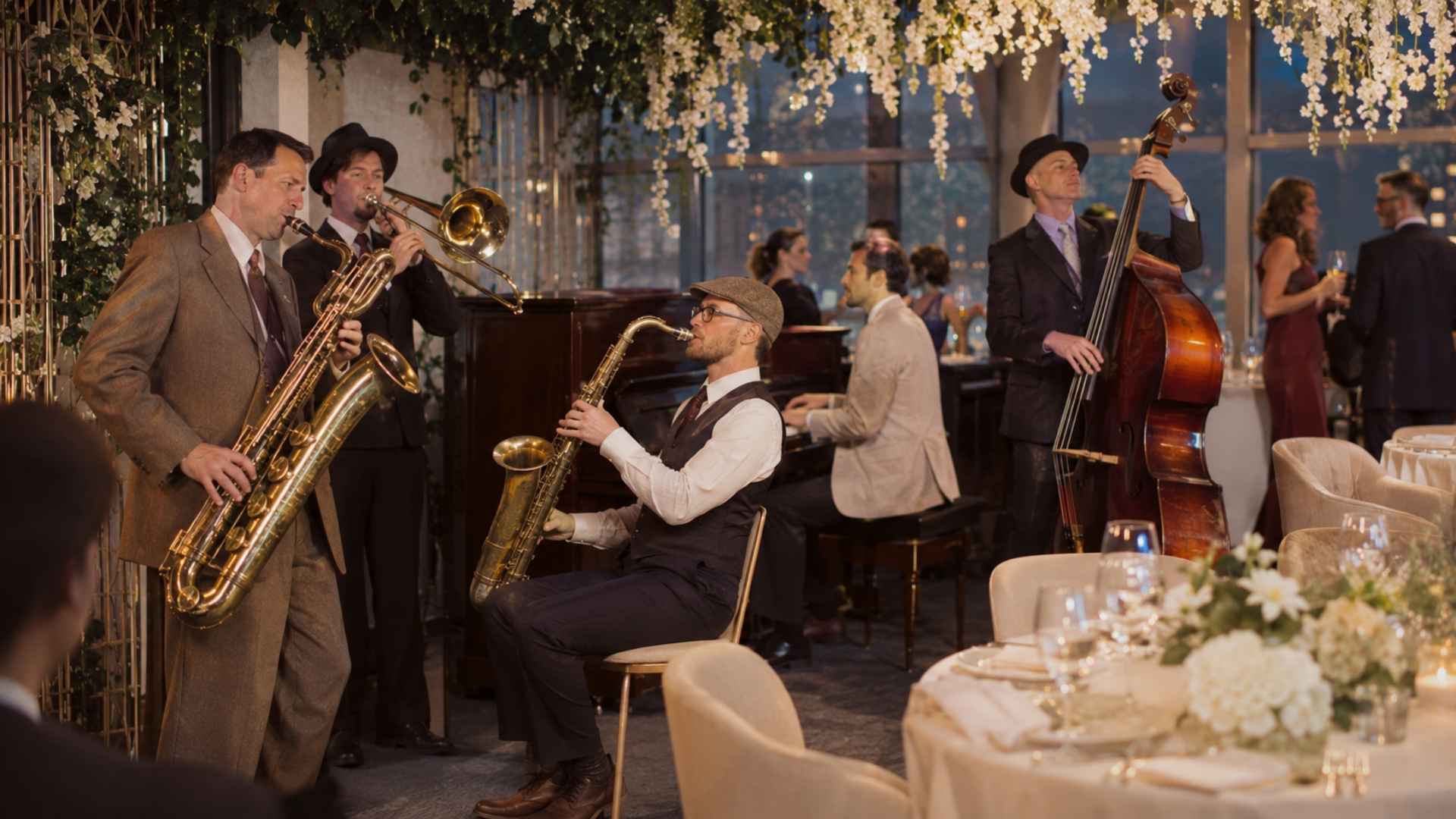
Live swing music has a distinctive place at private celebrations because its arrangements were shaped by both jazz performance and social dancing. Trumpets, trombones, saxophones, and rhythm instruments can produce the layered sound associated with the American swing era. At weddings, anniversary parties, and formal receptions, those musical characteristics provide options, from restrained instrumental passages during a meal to rhythm focused selections intended for dancing.
Rooted in African American jazz traditions, swing became a major form of American popular music during the 1930s and early 1940s. Orchestras led by Duke Ellington, Count Basie, and Benny Goodman helped establish its public identity, while smaller groups also played an important role. Their recordings preserve a repertoire of arranged melodies, instrumental solos, and steady rhythms that musicians continue to perform. Modern live ensembles may interpret this material with different instrumentation rather than reproduce every historical arrangement exactly.
Private events introduce conditions that differ from a concert hall or public dance venue. Guests may be eating, talking, listening, or dancing at different times, and the performance area may share space with tables and service staff. Consequently, musical pacing, ensemble size, acoustics, and event scheduling all influence the presentation. Swing’s flexibility explains its role beyond background music associated with one period.
Swing Music and Its Place in Social Gatherings
Swing developed into a widely recognized dance music style during the 1930s, when large orchestras performed in ballrooms and appeared on radio broadcasts. The style combined written ensemble passages with improvised solos, allowing individual musicians to emerge from a coordinated group sound. In New York, the Savoy Ballroom in Harlem became closely associated with Lindy Hop, a partner dance connected to swing rhythms. These settings linked listening with social dancing.
Rhythmic emphasis is one of swing’s defining features. Musicians often accent beats two and four, use uneven subdivisions of the beat, and support melodies with a walking bass line. The resulting pulse can accommodate several kinds of movement, including Lindy Hop and simpler social dancing. Faster numbers tend to serve a different purpose from slower standards, however. During a seated dinner or reception, a moderate tempo and restrained volume generally leave more room for conversation than an energetic dance arrangement.
Ensemble Size and Musical Arrangements
Traditional big bands commonly include fifteen or more musicians, with separate trumpet, trombone, and saxophone sections supported by piano, bass, drums, and sometimes guitar. Such groups can perform detailed written arrangements in which different sections exchange melodic phrases or play contrasting harmonies. Smaller swing groups may use only a few players while retaining a similar rhythmic character. These formats are not interchangeable: a compact ensemble allows a different balance of instruments, while a full big band offers a wider range of orchestral textures.
Brass and Reed Sections
Trumpets and trombones supply many of the bright accents and harmonized phrases associated with classic big band arrangements. Saxophones often carry melodies in blended section passages, while clarinets may feature in particular arrangements or smaller groups. Musicians can alternate between tightly arranged material and individual solos, creating contrast without changing the basic composition. In a private room, the natural projection of brass instruments also makes placement and volume control important, especially when the audience is seated close to the performers.
Rhythm Section and Tempo
Piano, bass, and drums form the rhythmic foundation of many swing ensembles, with guitar included in numerous traditional configurations. Walking bass lines typically outline harmony through a succession of notes, while the drummer maintains the pulse and the pianist contributes chords or short responses. Tempo and articulation affect whether a piece feels relaxed or dance oriented. For private functions, the same general musical style can therefore accompany quiet arrival periods, formal meals, and later dance sets without requiring identical intensity throughout the event.
Vocal Standards and Instrumental Pieces
Swing repertoire includes both instrumental works and songs associated with jazz vocalists. Familiar standards may feature a singer supported by brass and reeds, while instrumental numbers provide space for section writing and improvisation. Duke Ellington’s “It Don’t Mean a Thing (If It Ain’t Got That Swing)” remains a notable historical example of the style. Repertoire choices also affect the event’s character: lyrical ballads suit listening periods, whereas medium and up tempo arrangements are more closely aligned with social dancing.
Practical Considerations for Private Performances
Venue conditions have a direct effect on live band arrangements. Musicians need sufficient floor space for instruments, music stands, microphones, and safe cable routes, along with access for unloading equipment. Large ensembles require more room than trios or quartets, and outdoor performances need appropriate shelter for instruments and electrical systems. Room surfaces also matter: hard walls and floors can increase reverberation, which may reduce clarity when several brass and reed instruments play together. These requirements should be assessed before a performance schedule is finalized.
Sound checks allow performers and technicians to test microphones, monitor levels, and the balance between sections. Event planners commonly arrange these checks before guests enter the room, reducing disruption to speeches or dining. Amplification is not necessarily identical for every band; it depends on room size, musical forces, and the presence of vocals. Venues may also impose sound limits or curfews. Because local requirements differ, organizers should confirm the applicable rules rather than assume a standard volume or finishing time.
Performance timing works best when the program reflects the event’s sequence. Music for guest arrivals may call for shorter, quieter selections, while dancing generally permits longer sets and stronger rhythmic emphasis. Planned breaks should be included in the running order, with any recorded music between sets discussed in advance. Coordination among the bandleader, venue staff, and event organizer helps protect setup time and avoid conflicts with announcements or meal service. Within those practical boundaries, live swing remains a historically grounded form of ensemble music suited to both attentive listening and shared dancing.