
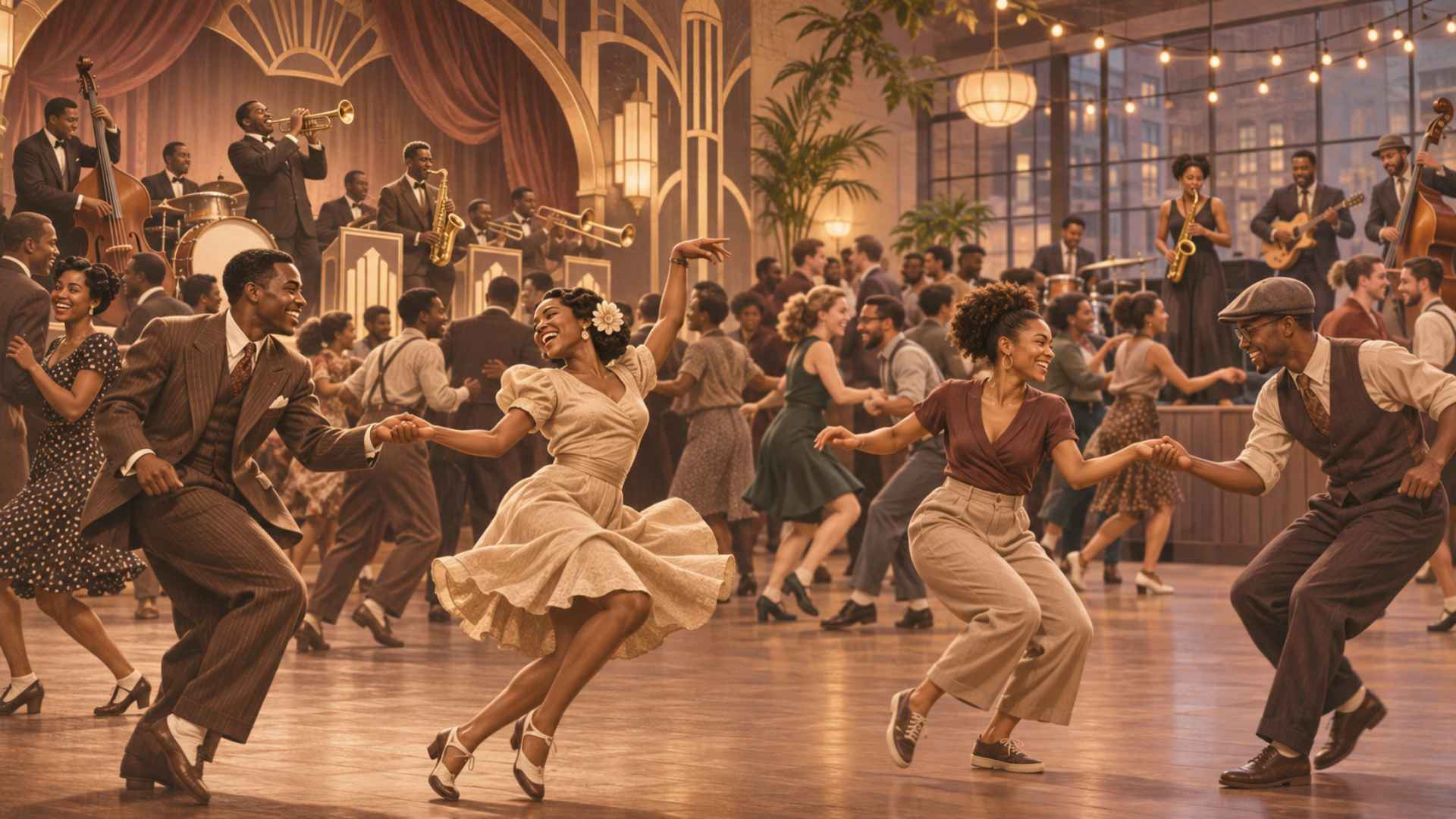
Swing music became a major part of American popular culture during the 1930s and 1940s, when jazz orchestras supplied the sound of radio broadcasts, recordings, and crowded dance halls. Its appeal rested on a recognizable rhythmic pulse, arrangements for large ensembles, and room for individual musicians to improvise. Dancers responded with steps that reflected the accents and pauses within the music. Although swing is associated with a particular historical period, its influence reaches into later jazz, social dance, and live music traditions.
The history of swing also reflects the central role of African American artists in twentieth century entertainment. Musicians and dancers developed new forms within communities shaped by migration, urban nightlife, and the Harlem Renaissance. Their work reached national audiences through touring bands, film, and commercial recordings, often within an industry marked by racial inequality. Performers did not always receive equal access to venues, contracts, publicity, or recognition, even when their artistic contributions helped define the style. Contemporary swing events draw on that history while adapting to different venues, musical groups, and levels of dance experience.
The Origins of Swing Music and the Savoy Ballroom
Swing grew from earlier jazz and blues traditions rather than appearing as a completely separate musical form. By the early 1930s, large orchestras had developed arrangements that placed brass and reed sections in dialogue, supported by piano, bass, drums, and sometimes guitar. Band leaders such as Duke Ellington, Count Basie, Fletcher Henderson, and Benny Goodman helped shape the sound heard by broad audiences. From the early 1930s through the mid 1940s, swing occupied a prominent position in American popular music, aided by radio, records, and live performances.
In Harlem, New York, the Savoy Ballroom provided an important meeting place for dancers and jazz orchestras. The venue opened in 1926 and became closely associated with the Lindy Hop, a partner dance developed by African American dancers during the late 1920s and 1930s. Unlike many establishments during segregation, the Savoy welcomed Black and white patrons. Its dance contests encouraged improvisation and experimentation, while appearances by prominent bands connected local dance traditions to the wider music industry. The venue remained open until 1958, long after swing’s peak as mainstream popular music.
Musical Rhythm and the Main Styles of Swing Dance
A swing performance often uses a steady four beat pulse, with particular emphasis on the second and fourth beats. Bass lines and drums maintain momentum while horns play written passages, short repeated phrases, and solos. Many performances give pairs of eighth notes an uneven duration, producing the rhythmic feel associated with swing jazz. Syncopation places accents at unexpected points within a measure, adding variety without removing the underlying beat. Not every swing era orchestra sounded alike: Ellington’s compositions, Basie’s rhythm section, and Goodman’s clarinet led arrangements offered distinct musical approaches. Some bands favored intricate concert arrangements, while others built their reputations around blues forms and dance friendly tempos.
The Lindy Hop combines partner connection with individual footwork and improvisation. Dancers use six count and eight count patterns, turns, and a characteristic swing out that moves partners between closed and open positions. Charleston steps also became part of the swing dance vocabulary, while Balboa developed as a close position dance associated with crowded Southern California ballrooms. East Coast Swing later emerged as a simplified form taught widely in ballroom and recreational settings. These styles share musical roots but differ in posture, movement, and typical tempo. Aerial moves belong mainly to practiced performances, not ordinary crowded social floors.
Cultural Legacy and Swing Dance in the Present Day
Swing’s reach extended beyond ballrooms through radio broadcasts, films, and stage productions. Professional groups such as Whitey’s Lindy Hoppers brought African American dance innovations to national attention. Frankie Manning, a member and choreographer of the troupe, helped develop group routines and aerial movements that became associated with performance Lindy Hop. Film appearances preserved examples of the dance, although entertainment media did not always represent its creators fairly. The widespread popularity of swing also occurred during the Great Depression and World War II, periods that shaped public leisure and the music business.
Interest in the Lindy Hop declined after the swing era, but the dance never disappeared completely. A revival gathered momentum during the 1980s and 1990s, aided by teachers, archival footage, and contact with dancers from its original generation. Manning returned to teaching in the 1980s and received a National Heritage Fellowship from the National Endowment for the Arts in 2000. Dance schools, community groups, and international festivals have since helped preserve the form. Modern events may feature recorded jazz, small live ensembles, or full big bands, depending on local resources.
Swing dance remains a social activity rather than only a staged performance. Participants practice timing, coordination, and partner communication, often in classes that separate introductory steps from advanced material. Social dances generally place emphasis on floor awareness, consent, and adjustments to the tempo and available space. Beyond recreation, the continued study of swing offers a practical connection to jazz history and African American cultural contributions. Historic recordings and films help dancers compare techniques across generations, but direct practice remains important because partner connection cannot be fully represented on a page. Its lasting place in music and dance comes from the exchange between live rhythm, personal interpretation, and shared movement.